How to register your systematic review on PROSPERO – for Newbies

Hi all, I wish you have a wonderful New Year. Because it is a holiday season and everyone is in a festive mood, I will keep this post very short and fun to read. This is the third post on systematic reviews, and if you follow all the posts step by step then you will be able to complete your systematic review by the end of this series 🙂

Hope you are ready with your review protocol, if not go ahead and do it now (https://scienceiq.wordpress.com/2018/12/17/how-to-write-the-protocol-for-your-systematic-review/). Next, we move on to registering it on Prospero.

Step 1 – Open the browser:

I have given the link here (https://www.crd.york.ac.uk/PROSPERO/)
Just like any other website, you need to sign up first.


Step 2 –  Go to my PROSPERO

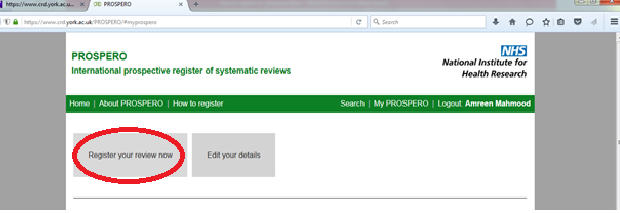
After signing in, go to “my PROSPERO” in the right corner. Then, click on “Register your review now.”

Step 3: Choose your review type

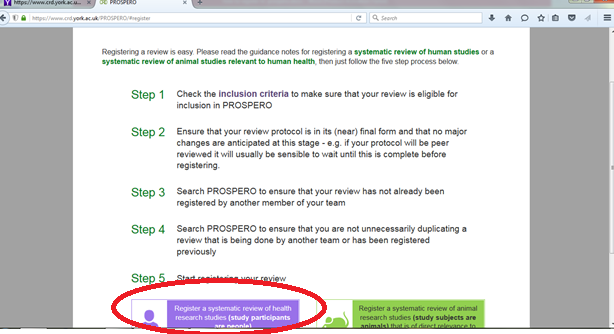
Once you click on register your review, then you need to select your review category, i.e., is your review on human participants or animal model.

Step 4 – Answer a few questions before you go to the registration

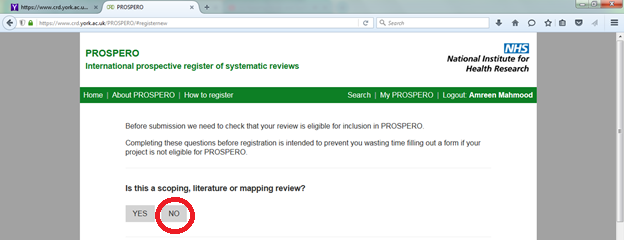
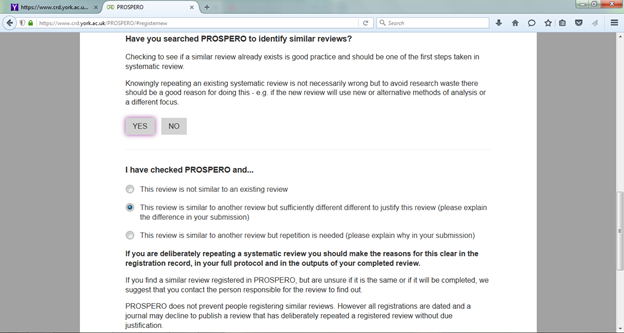
The first question will be: whether it is a scoping or literature or mapping review. If you click “YES” then you won’t be able to register further because currently, Prospero is only registering systematic reviews. So, click on “NO.”

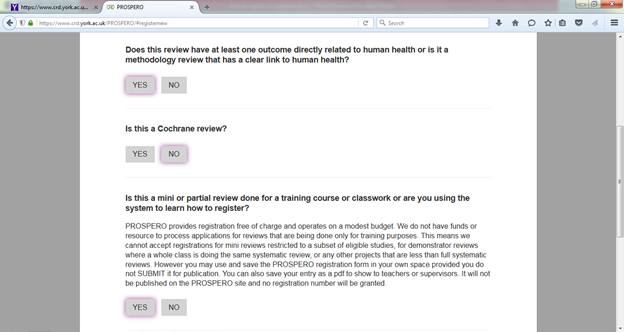
Next, keep answering the questions as shown in the picture. You also need to specify if there is another review which exists on the same topic and if so, why do you wish to do it or how different is your review from the other one.

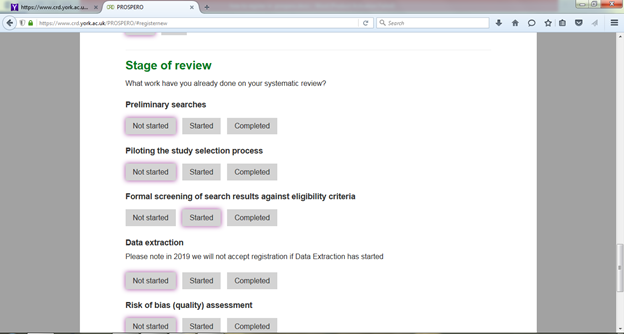
You will need to specify the stage of your review. Don’t worry if all your answers are “not started.” It won’t matter.

Step 5 – Begin registering

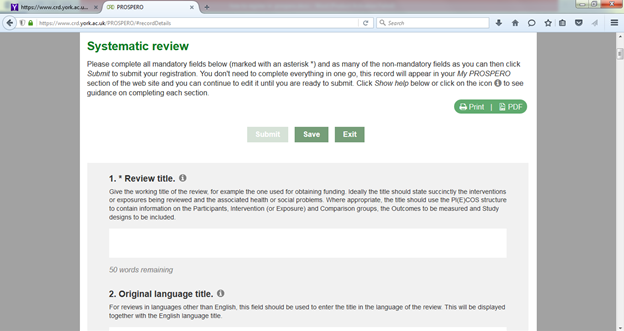
Once you have answered all the questions, you can go ahead to the main 40-item registration form. It is exactly like your protocol. So, if you have prepared your protocol, then you can simply copy-paste it here.  You can also save it and keep filling it at your pace. You may also wish to copy the entire form in a word doc and then fill it (it may take more time).

Last few questions have to be filled when you have completed the entire review. So don’t be afraid to leave those sections blank.

PROSPERO Registration form

That’s it. It is so simple to register your review. Make sure that your PROTOCOL is well-written; then registration is a cake-walk.  I have also linked the pdf on ‘guidance for registering on Prospero’ for more clarity and details. https://www.crd.york.ac.uk/prospero/documents/Registering%20a%20review%20on%20PROSPERO.pdf)

Hope you have a blessed 2019! Stay connected and comment below if you have any queries.

How to write the PROTOCOL for your systematic review

Hi all, welcome back! Hope you have read and enjoyed the previous blog on “How to do a systematic review-10 simple steps for beginners.” In case you missed it, you can still go back and read it.

We are moving to the details of each step involved in a review. Now that you have decided your amazing topic and formulated the research question, it’s time to write down your review protocol. You can get detailed information on PRISMA website (PRISMA Link:  http://prisma-statement.org/Protocols/ProtocolGuidance). But as promised I have simplified the steps which you should follow in writing your review protocol. So, let’s dive in.

  • Title:

Make sure that the title of your review should include the word ‘systematic review’ in it. It helps in identifying the article as a systematic review instantly. E.g., the title of my review was “Effect of TENS on spasticity in adults with stroke; A systematic review and meta-analysis.”

  • Authors and their contribution:

Before you begin the review or you are at the protocol stage, you should be sure of your team members and how they are going to contribute to it. Divide the work initially for smooth and hassle-free completion of the review. E.g., Author 1 and 2 will screen and extract the data. Author 3 will conduct the meta-analysis or risk of bias; Author 4 will be contacted in case of disagreement, etc.

  • Support/sponsor/funder:

Mention the name of your funders or sponsors if you have got support for conducting the review.

  • Introduction – rationale and objective:

Prepare a brief introduction for your review with emphasis on the need for conducting the review. Why this review was required, what is already known and what do you wish to know through this review. Is there no evidence or conflicting evidence on that particular topic? Remember that the need should be convincing enough for the readers and editors of course!

  • Methods:

As I explained in the last post, you should discuss your methods with your supervisor or senior colleague because it determines the quality of your review. Write down the eligibility criteria, PICO format, study design, setting, time frame, years considered, language, and publication status for including the studies. Also, mention the databases which you planned to search. Whether or not you wish to include grey literature. It is a good idea to prepare the search strategy of at least one database and write it in the protocol.

  • Data extraction:

Give a clear picture of how the data extraction will be done. Will you develop and pilot test the extraction sheet or will you use an existing one? It is always better to adapt the data extraction sheet from an existing one which suits your study requirement. We will discuss further on it later.

  • Outcomes:

It is the heart of your review. Mention about all the outcomes which you wish to extract and analyze in the study. Which outcomes do you want to exclude and why?

  • Critical appraisal/risk of bias analysis:

This is again a critical and unique component of a systematic review. You will have to write down how will you analyze the included studies or how will you do the risk of bias. Mention the scale or tool which you will use for appraising the article.

  • Data Synthesis

Give details on how you will summarize the included studies, i.e., narratively or quantitatively. Ideally, you should do both. Qualitative synthesis would consist of the way you wish to present your data. E.g., an effect of a treatment alone or effect of treatment as an adjunct, or effect in the chronic or acute stage, etc. Details on quantitative synthesis/meta-analysis would include describing the summary measures, subgroup analysis and heterogeneity in the data.

  • GRADE your review:

You may also wish to do GRADE (Grading of Recommendations Assessment, Development, and Evaluation) to rate the quality of evidence and develop recommendations in guidelines. More info on http://www.gradeworkinggroup.org/

So, these were some core areas which you should include in your protocol. It would not only help you in building your review of good quality, but it will also help you in planning ahead. A good idea is to keep a timetable for completing the review, right from screening the articles to preparing the manuscript. Otherwise, it may get excessively delayed (don’t ask me how much time I took to complete mine. Once you have written the protocol, register it in PROSPERO, and you are good to go! Best of luck 🙂

Reference

  1. ShamseerL, Moher D, Clarke M, Ghersi D, Liberati A, Petticrew M, Shekelle P, Stewart L, RISMA-P Group. Preferred reporting items for systematic review and meta-analysis protocols (PRISMA-P) 2015: elaboration and explanation. BMJ. 2015Jan 2;349(jan02 1):g7647.

How to do a systematic review –10 simple steps for beginners

Hello all, I know you are beginning to do a systematic review and looking for help to start. I am happy to help you in understanding each step and guide you in the process.

Systematic reviews can be overwhelming in the beginning, and most of the online modules or workshops are unable to simplify the steps of a systematic review. I was in the same situation a few years back, but I was lucky to have people in my team who helped me understand each step gradually.

As a personal experience, I would suggest you focus on one step at a time and not go through the entire method at once. It can be scary and frustrating. For the ease of understanding, I have simplified the 10 steps for conducting a systematic review. I recommend you NOT to do a systematic review alone. You need a minimum of two people to do a systematic review. I will give you the details within each step in upcoming blog posts. So let’s begin.

  • Decide your amazing topic

Choose to do a review on a topic which fascinates you (otherwise the entire process can be extremely tedious). This would usually include searching the literature and finding the gaps in evidence. Once you have decided your topic go to PROSPERO (link) and search if a similar review is ongoing elsewhere. It is a good idea not to do the same review otherwise you will waste your energy duplicating the evidence.

  • Develop your research question

If you have decided on a novel topic, then it’s time to write down your research question. This is a very important step. Think of questions which you want to answer at the end of your review. It is crucial to take expert advice either from your supervisors or senior colleagues.

  • Write a protocol for your review

That’s right! Just like any other research, you first need to write down your protocol. Develop your PICO format, i.e., P=population, I=intervention, C=comparison, O=outcome

Also, decide the type of study designswhich you wish to include in your review. It can be a qualitative, observational or randomized controlled trial. Figure out the inclusion and exclusion criteria for including the studies in your review. This also requires some expert advice.

  • Register in PROSPERO

Once you have finalized the protocol anddecided your team, then it’s time to register in PROSPERO. Registering in PROSPERO helps in two ways. Firstly, it gives transparency and rigor to your methodology. Secondly, it prevents other in conducting the review on the same topic.

  • Build your search strategy

This is one of the most vital steps in a systematic review. Your search terms should encompass all relevant studies pertaining to your review question. You don’t want to miss out any relevant study because your search strategy was not good enough. If you are very new in building a search strategy, then you can even ask for help from your librarian. Otherwise, you need to find out a maximum number of terms which are required to retrieve all the studies. How to develop a detailed search strategy is a big topic in itself which we will learn later!

  • Run the search in different databases

Now that you have the search strategy ready, you should start running the search in different databases. Databases will depend on which discipline you belong. For research in health sciences, databases like PubMed, COCHRANE, EMBASE, CINAHL, Web of Science, Clinical Key, Pedro are few examples. You should run the search in a minimum of three databases to be sure that you have not missed out relevant studies.

  • Remove duplicates and start screening

Once you have run the search in all the databases and imported the files in your PC, then remove duplicates. You are likely to have many duplicate studies because you have searched multiple databases. You can either do it manually (difficult and time-consuming) or use software like Revan, Rayyan, Mendeley, Endnote, etc. Start screening the titles of all the studies for inclusion and exclusion. I will write a post on ‘How to screen the studies’ separately. 

  • Extract your data

Now that you have screened the articles for title, abstract and full text, it’s time to develop a simple data extraction sheet or excel sheet. Start extracting the required information from the included studies like title, authors, year, journal, study design, number of participants, characteristics of participants, intervention, outcome measures and results including mean values and p-values.

  • Decide if your review is suitable for performing a meta-analysis

If your data is homogenous (similar outcome measures and similar study participants) then you can think of performing a meta-analysis. You can take help of your statistician for meta-analysis or you can even DIY! A separatesession on it 😉

  • Start writing your systematic review

As obvious, it is a huge topic to discuss. I will talk about a few essential points in writing a review. First, prepare a table of all the included studies. Then begin writing your methods section. Give details of how your search was conducted and how many articles did you finally include. Also, talk about how you have dealt with the risk of bias in the studies. Then start writing your results section. Summarize the findings of each study and interpret it. Write the risk of bias summary. Then write your discussion on what have you interpreted from your results. How is it different/similar from previous studies/reviews, how have you contributed to the existing knowledge, and what should be the future scope for conducting other studies. Last, write your introduction with convincing reasons for performing your systematic review.

That’s it! Go ahead and publish your fantastic review.